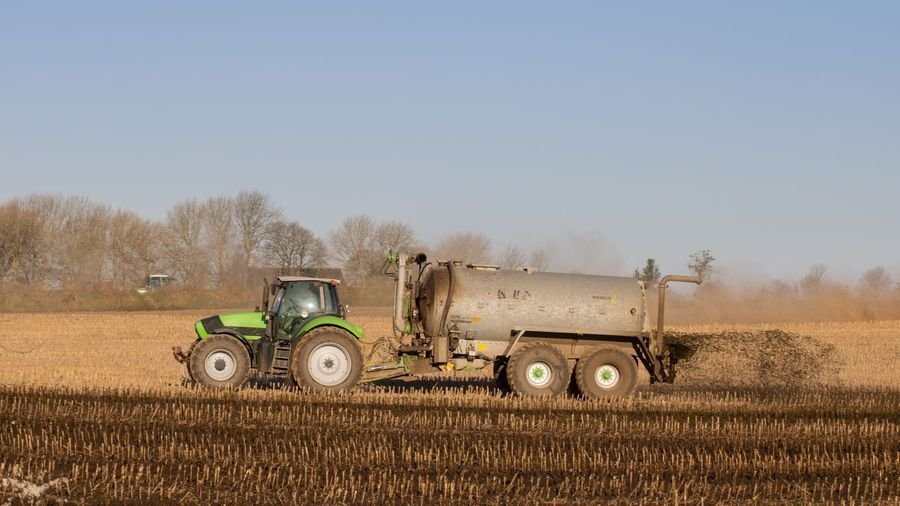
Fertilizers
Diammonium Phosphate (DAP)
18% nitrogen and 46% phosphate in one highly water-soluble granule — the world's leading phosphate fertilizer.
DAP supplies 18 per cent nitrogen and 46 per cent available phosphate in a single granule, making it the most concentrated widely available phosphate source. Both nutrients are highly water-soluble, so the granule begins feeding the crop as soon as there is moisture in the soil.
It is the standard product for establishment fertilization — applied at or before sowing, when phosphorus availability determines root development and early vigour.
Why phosphorus placement matters
Phosphorus barely moves in soil. Unlike nitrate, which travels with soil water, phosphate ions bind rapidly to soil minerals and stay within a centimetre or two of where they were placed. A root has to grow to the phosphorus rather than the other way round.
That is why DAP is banded near the seed rather than broadcast, and why placement accuracy has more effect on phosphate response than on any other nutrient. Keep the band close enough to be reached, but far enough to avoid ammonia injury to the germinating seed.
The alkaline microsite
As a DAP granule dissolves it creates a zone of pH 7.5 to 8.0 around itself, along with free ammonia. On acid soils this is helpful — it temporarily reduces the aluminium and iron fixation that locks up phosphate. On already alkaline or calcareous soils it is less advantageous, and monoammonium phosphate, which creates an acidic microsite instead, often performs better.
The ammonia released is also the reason for the seed placement caution. Direct contact between DAP and germinating seed, particularly for sensitive crops, can damage the seedling.
Application guidance
- Band at or below seed depth, offset from the seed row
- Apply at sowing or shortly before — phosphorus is needed early
- Avoid direct seed contact with sensitive crops such as canola and pulses
- Prefer MAP where the soil is strongly calcareous or already alkaline
- Blend readily with urea, potash and sulphate for compound applications
- Base rates on a soil phosphorus test rather than a standard recipe
Crops and systems
DAP is used across cereals, maize, rice, oilseeds, cotton, sugarcane, pulses and most horticultural crops. In bulk blending operations it is a core component, combining with urea for additional nitrogen and with muriate or sulphate of potash to build a complete NPK to a specific soil test.
Typical specification
| Total nitrogen | 18% minimum |
|---|---|
| Available P₂O₅ | 46% minimum |
| Water-soluble P₂O₅ | 41% minimum |
| Moisture | 2.5% maximum |
| Granule size 2–4 mm | 90% minimum |
| Bulk density | 0.90 – 1.00 t/m³ |
| Cadmium content | Certified to destination limit |
| Packing | 50 kg bags · 1 MT jumbo · bulk |
Values are indicative and given for guidance. Contract specification is agreed in writing and certified per batch on the certificate of analysis issued with each shipment.