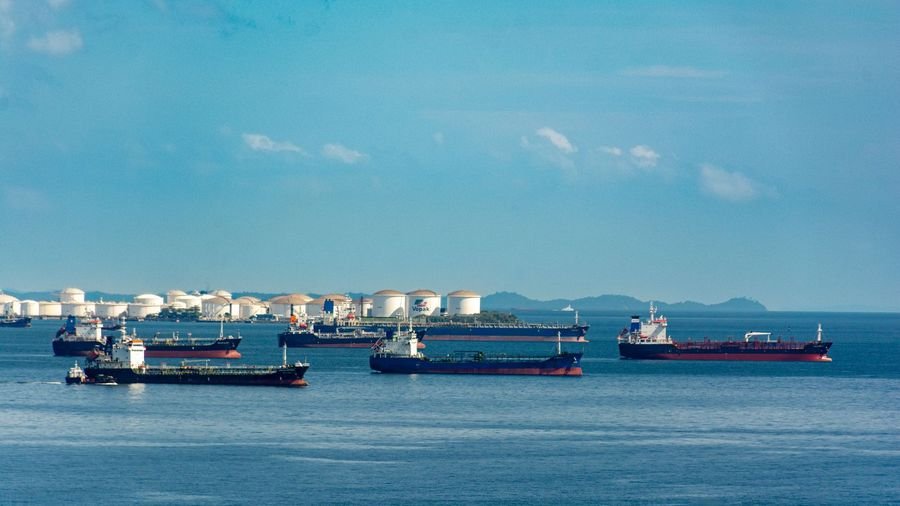
Fuel Oil
Fuel Oil cst 380
The most widely traded residual fuel grade worldwide — the lowest cost per unit of energy for plant equipped to handle it.
Fuel oil cst 380 is the global benchmark residual grade, with a maximum kinematic viscosity of 380 centistokes at 50 °C. It is the standard bunker fuel for deep-sea shipping and the default for large industrial and power installations that have the heating and purification equipment to use it properly.
It offers the lowest cost per unit of delivered energy of any liquid fuel, provided the plant can handle it. That proviso is the whole story: without adequate heating, separation and burner maintenance, the savings evaporate into operating problems.
Principal uses
- Main propulsion on deep-sea vessels, usually as HSFO with scrubbers or VLSFO without
- Heavy fuel oil power stations and large diesel generating plant
- Large industrial boilers and process furnaces
- Cement and steel plant kilns and reheating furnaces
- Refinery and petrochemical process heaters
What the plant needs
- Heated, insulated storage held at 50 to 60 °C
- Preheating to 110 to 130 °C to reach injection viscosity of 12 to 15 cSt
- Steam or electric trace heating on all transfer lines
- Centrifugal separators sized for the grade, run in series where required
- Fine filtration downstream of separation
- Regular burner tip inspection and cleaning
Managing the risks
Three issues cause most of the trouble with 380 grade. Catalytic fines — hard aluminium silicate particles carried over from refinery catalyst — will score liners and rings unless separation is effective. Incompatibility between stems can drop asphaltenic sludge that blocks filters and fills purifiers. And insufficient preheat produces poor atomisation, soot and fouled heat transfer surfaces.
All three are manageable. We supply full analysis including Al+Si content, and recommend a compatibility test before commingling stems from different sources.
Sulphur options
We supply 380 grade at 3.5% sulphur for scrubber-fitted vessels and for industrial sites whose permits allow it, and at 0.5% as VLSFO for compliance without abatement. Where a site is subject to a local emissions limit, we will supply against that figure specifically rather than a nominal grade.
Typical specification
| Kinematic viscosity @ 50 °C | 380 cSt maximum |
|---|---|
| Density @ 15 °C | 991.0 kg/m³ maximum |
| Sulphur content | 0.50% or 3.50% m/m to contract |
| Flash point | 60 °C minimum |
| Pour point (summer) | 30 °C maximum |
| Water content | 0.5% v/v maximum |
| Ash | 0.10% m/m maximum |
| Al + Si | 60 mg/kg maximum |
| Gross calorific value | Approximately 42.0 MJ/kg |
Values are indicative and given for guidance. Contract specification is agreed in writing and certified per batch on the certificate of analysis issued with each shipment.